The USHA believes there is a need for communication with the membership on a greater frequency on topics of interest to the membership. This is the first in a continuing series to engage the members on issues of interest or concern.
On this occasion, we turn to the topic of The Ball. There is not a one of us indifferent to the quality, quantity, and costs of The Ball. To explain where we are, we must go back to where we were.
Since the summer of 2011, we have been using the “21” ball which is manufactured in Ireland. A consistent and durable ball remains the goal; however , quality had noticeably declined, resulting in a considerable number returned to USHA right out of the cans. There were a number of factors, but one specific variable was the method of producing the pressure in the ball. After the two halves of the ball were formed, a small wafer of temperature-sensitive material was put into the two halves and sealed together. The ball was heated to a temperature that caused the wafer to turn to gas, producing the pressure inside the ball. The inconsistency came from the specification for the wafer, which was 1 gram plus or minus 0.1 gram. This allowed a variation of approximately 20%, from 0.9 g to 1.1 g of wafer.
A growing contingent of players wanted to research a solution with the intent to produce a consistent product. As a result, a second company in Cincinnati began research and development for an alternative ball. During initial development, there were issues of more bounce than was desired and a thin coating on the surface from the manufacturing process that induced undesirable bounce from the sidewall and backwall corners. Further refinement in cooperation with the production company in Taiwan removed those characteristics, and the ONE ball was approved as a USHA ball. Differentiating the two balls, the ONE ball uses a pressure chamber to capture an exact ambient pressure when sealing the two halves of the ball, thereby eliminating pressure variations.
As time went on, with two competing manufacturers, each company pushed each other to resolve issues, thereby improving the quality and playability of both their respective products. This has given us two balls with two suppliers from two separate manufacturing sites. The endgame is to have multiple ball suppliers and to let the market decide which one the players ultimately prefer.
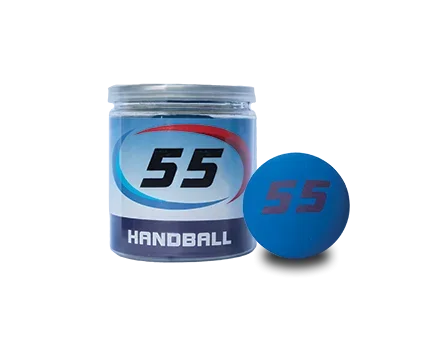
Beyond that, the USHA has long sought to have a ball that is more player friendly to those whose hands find the impact of the “21” Ball and the “ONE” too much for their hands, elbows and shoulders. A harder ball also makes it hard to get new players to enter and continue the sport. At the specific request of the USHA Board, the Cincinnati group undertook to develop a more user-friendly handball, a lighter ball with slightly less pressure. Players who tested samples and prototypes preferred the user-friendly ball, and that project developed our latest introduction: the 55 ball, which is a reference to the nominal weight being 55 grams. The nominal weight of the other two balls is 61 grams. The result is a slightly lighter ball that hits your hand with less mass and lower pressure making it ideal for players whose hands are more sensitive to impact. Specifically, older or novice players who would have to stop playing due to pain find themselves able to continue to play The Perfect Game.
So, where do we stand today on which balls are authorized for USHA play?
All three balls, the “21” ball, the “ONE” ball, and the “55” ball, are authorized and approved for any and all local, state, and regional tournaments, at the selection of the respective Tournament Director.
Last year, the Women’s Commissioner, Kristen Hughes, at the request of the women playing in the Women’s Classic, requested that the upper division of that Tournament be allowed to use the Red 21 ball while keeping the White 21 for the beginner or novice skill divisions. The Red 21 and White 21 were requested based on player ability and experience, not gender. The USHA Board approved this change to follow what the membership wanted.
Until the advent of the “ONE” ball, the “21” ball was the only authorized and approved ball for all USHA National Tournaments. Three years ago, the One-Wall Small Ball community overwhelmingly urged and requested the USHA to sanction and approve the “ONE” ball for the USHA National One-Wall, Small Ball Tournament. With the concordance of the members of that specific community, the Board approved the “ONE” ball for that National Tournament, only. Again, The Board followed what the membership requested.
Currently, the Women’s Classic is authorized to use the “21” and the White “21” for their two divisions. The One-Wall Small Ball National is authorized to use the “ONE” ball. All other USHA National Tournaments are authorized to use the “21” ball.
There is expressed interest in some of the Three-Wall community to consider the ONE ball for the Toledo National Tournament. To be fair to our players, and to be fair to our suppliers, we have approved that each player at the 3-Wall Nationals in Toledo in 2023 will be gifted a “ONE” ball. Our intent in this endeavor is to introduce the most dedicated players of that discipline to the ONE ball en masse, to generate a common experience with this ball. With that, we believe handball players will let us know what they want.
The Board has no interest in driving the members to a position they do not want. We want you to have a choice and also want to deliver the best products to our players. We are here to serve you, and firmly believe you collectively are the best barometer for us to use in making decisions on the game. Your critiques and feedback are essential in Game Committee discussions and Board decisions on balls and equipment.
In the meantime, we have two suppliers giving us redundancy and a safety net guaranteeing a supply of balls from two distinct parts of the world with a choice of three balls to suit your personal preferences and physical abilities.
Local, state, and regional Tournament Directors have a choice of balls to meet the needs of their players. Do let us know the quality of the balls you use. Do let us know how your tournaments went with each choice. Let us know if and when we should consider approving more ball options for the National Tournaments.
MAUMEE, Ohio — Another fantastic year of the USHA Three-Wall Nationals concluded Monday morning on a hot and sunny day. The weather was great all week, and players were treated to a tremendous number of entertaining matches. Sean Lenning and Danielle Daskalakis played immaculate all weekend, adding to their three-wall open singles title count. Tywan Cook wowed the crowd in his one-wall singles final performance over Nazir Marston as we welcomed several new one-wall players to the tournament. Several age divisions had incredible matches and came down to the last few points. It was an all-around exciting week of handball!
Lenning reminded everyone of his greatness when he won his astonishing fourteenth national three-wall open singles title in front of a pack crowd at the George D. Miller Handball Courts. Lenning squared off with Luis Cordova, who has been as good as anyone on the three-wall court over the last year, including beating Lenning a few months earlier in Kansas City.
Lenning came out firing and built a big lead in game one, but Cordova refused to give up. He made Lenning earn every point and seemed to tire his opponent with each rally. Lenning finally closed out game one 21-11. Game two was similar to the first, with Lenning sustaining a lead the whole way through, but Cordova was making it difficult for Lenning to cross the finish line. On the rally for match point, while running backwards, Lenning flipped the ball up to the ceiling with enough power on it to go over the head of Cordova, giving him the title. It was shot that maybe only Lenning could pull off, something we’ve come accustomed to the past several years.
Cordova was able to bounce back in the open doubles final, teaming with his brother Daniel to defeat the reigning champions of Sam Esser and Shorty Ruiz. After dropping game one by a point, the Cordovas controlled the second and third game, never allowing their opponents into the match.
Danielle Daskalakis regained her Women’s Three-Wall Open Singles title after taking last year off. Daskalakis overcame Megan Dorneker, who was coming off an impressive victory over defending champion Ashley Ruiz. Daskalakis was equally impressive in her semifinal over Mikaila Esser, which saw both players play an exceptional, hard-fought match.
Daskalakis was flawless in the final, as she was nearly all weekend. Her serves were filled with power and hop and when she earned a setup, she put it down. Dorneker, who has a very strong out the door serve herself, could never get into the match. A long match point for Daskalakis ended with a perfect left-handed pass down the right sidewall, a fitting end to an undefeated weekend across three divisions for Daskalakis. She held Dorneker to just 15 total points in the final match. Daskalakis success across different disciplines of handball is nearly unrivaled, as she boasts open singles titles on the one-wall, three-wall, and four-wall court!
Daskalakis later teamed up with Sandy Ng to win the Women’s Open Doubles division in both the three-wall, and the one-wall division. The three-wall victory came over back-to-back defending champions Mikaila Esser and Ashley Ruiz. Ng and Daskalakis played steady in both games and were able to hit their shots when it mattered most, winning 21-17 and 21-20.
In their One-Wall Open Doubles final, Daskalakis and Ng took out Beebee Miranda and Melissa Sky in two straight games.
Tywan Cook and Nazir Marston played the one-wall big ball singles final in front of a crowd filled with three-wall players who were amazed by their talent. After winning the first game, Cook rallied back from a 9-14 deficit in game two to win 15-14 and earn the title. Marston and Cook later teamed up to win the one-wall big ball doubles final over Mikey Mendoza and Los Pena in a thrilling tiebreaker.
A big thank you to all of the players who came out to support the tournament. The tournament always has a family reunion feel to it, and that’s because of the players who come year after year. Thank you to Richie Vera and the Castle Hill Handball Club for running the One-Wall events, which was a big success this year, including the Fun Division that allowed many three-wall players to try one-wall.
Lastly, thank you to the Toledo Handball Club for all of their hard work in preparing and running this tournament. The members of the club work nonstop to make sure everyone has a great time. It’s a lot of long days, and a tireless job, but their work does not go unnoticed, as they continue to put on the best tournament of the year.
Check out all of the latest National Champions and this year’s results HERE.
MAUMEE, Ohio — Saturday was the busiest day of the tournament, and the courts were filled all day with what seemed to be a record amount of tiebreakers.
The Men’s final is set Sunday as Sean Lenning is vying for another three-wall nationals singles title. Hoping to deny him this year is Luis Cordova, who has been one of the best three-wall players on the planet this past year.
In the first Men’s Semifinal, Lenning annihilated Shorty Ruiz in two quick games and looked motivated to add to his national title collection.
In the next semifinal, Cordova was able to tame the upstart Ivan Burgos who has been on a Cinderella run this weekend.
On the women’s side, play began in the quarterfinals. Danielle Daskalakis, Ashley Ruiz, and Mikaila Esser all advanced in dominant fashion to the semifinals. Megan Dorneker also clinched a spot in the semis, outlasting Sandy Ng in a tiebreaker and avenging her loss last year to Ng.
Ruiz will take on Dornerker and Daskalakis will face off with Esser on Sunday.
Several age divisions finished up their singles draw and many national champions were crowned. Check out all of the results HERE.
Another highlight on the day was a presentation of two prestegious awards and accomplishments.
First, Rich Goosmann was honored with the USHA volunteer of the year award. Goosmann has been a tremendous ambassador of our game for many years, and continues to do so each year. He has promoted the game in Ohio and has hosted several tournaments, making each one better than the last.
Next, Michigan’s Rick Graham was honored with his Grand Master sweater, given to players who have won 10 age division national titles. Graham was quick to thank his former parnters, and most of all his family for supporting him. Graham also has a chance to add another national title this weekend in the 75 doubles. See him below as he addresses the crowd with some of his family members behind him.
MAUMEE, Ohio — The 2023 USHA Three-Wall Nationals kicked off on Thursday at the Geroge D. Miller Handball Courts at the Lucas County Rec Center. The weather couldn’t of been any better, and the Toledo Handball Club’s famous hospitality was on full display. The tournament always have a family reunion feel to it, and player’s enjoyed catching up with friends.
Nearly all of the singles divisions began, and the spectators were treated to some great matches. The Men’s A Singles was the most exciting division of the day, and almost every match came down to the wire.
In the Men’s Open division, nearly all of the top seeds advanced, setting up some exciting quarterfinal matches tomorrow that will include the likes of Sean Lenning, Luis Cordova, Daniel Cordova, and Shorty Ruiz. The Women’s Open division will begin Saturday.
The 2023 USHA Three-Wall Nationals are here! Players and spectators will soon be making their way to the George D. Miller Handball Courts at the Lucas County Rec Center.
Draws and start times have been made available on the R2sports tournament website. View them HERE, and please know these are tentative, so check them each day leading up to the event.
We are appreciative of the new players making their first trip to Toledo. We hope you love it and tell your handball friends what they missed back home.
We’re also excited to work in partnership with the Castle Hill Handball Club for our Wallball Divisions, which include a NEW fun “Mixed Doubles” event.
All three-wall matches will be: Two games to 21 with a third 11-point tiebreaker, if necessary.
Wallball matches only: Rally scoring. Two games to 15 with a third 11-point tiebreaker, if necessary.
Continue to check this page for updates from the tournament. Good luck to all of our participants!
The USHA believes there is a need for communication with the membership on a greater frequency on topics of interest to the membership. This is the first in a continuing series to engage the members on issues of interest or concern.
On this occasion, we turn to the topic of The Ball. There is not a one of us indifferent to the quality, quantity, and costs of The Ball. To explain where we are, we must go back to where we were.
Since the summer of 2011, we have been using the “21” ball which is manufactured in Ireland. A consistent and durable ball remains the goal; however , quality had noticeably declined, resulting in a considerable number returned to USHA right out of the cans. There were a number of factors, but one specific variable was the method of producing the pressure in the ball. After the two halves of the ball were formed, a small wafer of temperature-sensitive material was put into the two halves and sealed together. The ball was heated to a temperature that caused the wafer to turn to gas, producing the pressure inside the ball. The inconsistency came from the specification for the wafer, which was 1 gram plus or minus 0.1 gram. This allowed a variation of approximately 20%, from 0.9 g to 1.1 g of wafer.
A growing contingent of players wanted to research a solution with the intent to produce a consistent product. As a result, a second company in Cincinnati began research and development for an alternative ball. During initial development, there were issues of more bounce than was desired and a thin coating on the surface from the manufacturing process that induced undesirable bounce from the sidewall and backwall corners. Further refinement in cooperation with the production company in Taiwan removed those characteristics, and the ONE ball was approved as a USHA ball. Differentiating the two balls, the One ball uses a pressure chamber to capture an exact ambient pressure when sealing the two halves of the ball, thereby eliminating pressure variations.
As time went on, with two competing manufacturers, each company pushed each other to resolve issues, thereby improving the quality and playability of both their respective products. This has given us two balls with two suppliers from two separate manufacturing sites. The endgame is to have multiple ball suppliers and to let the market decide which one the players ultimately prefer.
Beyond that, the USHA has long sought to have a ball that is more player friendly to those whose hands find the impact of the “21” Ball and the “One” too much for their hands, elbows and shoulders. A harder ball also makes it hard to get new players to enter and continue the sport. At the specific request of the USHA Board, the Cincinnati group undertook to develop a more user-friendly handball, a lighter ball with slightly less pressure. Players who tested samples and prototypes preferred the user-friendly ball, and that project developed our latest introduction: the 55 ball, which is a reference to the nominal weight being 55 grams. The nominal weight of the other two balls is 61 grams. The result is a slightly lighter ball that hits your hand with less mass and lower pressure making it ideal for players whose hands are more sensitive to impact. Specifically, older or novice players who would have to stop playing due to pain find themselves able to continue to play The Perfect Game.
So, where do we stand today on which balls are authorized for USHA play?
All three balls, the “21” ball, the “One” ball, and the “55” ball, are authorized and approved for any and all local, state, and regional tournaments, at the selection of the respective Tournament Director.
Last year, the Women’s Commissioner, Kristen Hughes, at the request of the women playing in the Women’s Classic, requested that the upper division of that Tournament be allowed to use the Red 21 ball while keeping the White 21 for the beginner or novice skill divisions. The Red 21 and White 21 were requested based on player ability and experience, not gender. The USHA Board approved this change to follow what the membership wanted.
Until the advent of the “One” ball, the “21” ball was the only authorized and approved ball for all USHA National Tournaments. Three years ago, the One-Wall Small Ball community overwhelmingly urged and requested the USHA to sanction and approve the “One” ball for the USHA National One-Wall, Small Ball Tournament. With the concordance of the members of that specific community, the Board approved the “One” ball for that National Tournament, only. Again, The Board followed what the membership requested.
Currently, the Women’s Classic is authorized to use the “21” and the White “21” for their two divisions. The One-Wall Small Ball National is authorized to use the “ONE” ball. All other USHA National Tournaments are authorized to use the “21” ball.
There is expressed interest in some of the Three-Wall community to consider the ONE ball for the Toledo National Tournament. To be fair to our players, and to be fair to our suppliers, we have approved that each player at the 3-Wall Nationals in Toledo in 2023 will be gifted a “One” ball. Our intent in this endeavor is to introduce the most dedicated players of that discipline to the ONE ball en masse, to generate a common experience with this ball. With that, we believe handball players will let us know what they want.
The Board has no interest in driving the members to a position they do not want. We want you to have a choice and also want to deliver the best products to our players. We are here to serve you, and firmly believe you collectively are the best barometer for us to use in making decisions on the game. Your critiques and feedback are essential in Game Committee discussions and Board decisions on balls and equipment.
In the meantime, we have two suppliers giving us redundancy and a safety net guaranteeing a supply of balls from two distinct parts of the world with a choice of three balls to suit your personal preferences and physical abilities.
Local, state, and regional Tournament Directors have a choice of balls to meet the needs of their players. Do let us know the quality of the balls you use. Do let us know how your tournaments went with each choice. Let us know if and when we should consider approving more ball options for the National Tournaments.
From the manufacturers of the ONE Ball, introducing the revolutionary 55 Ball – a game-changer designed exclusively for handball players!
The 55 is a PREMIUM HANDBALL with the peak performance features that handball players demand. 55 Handballs are approved for USHA-Sanctioned Tournaments.
We’re thrilled to unveil the remarkable 55 Ball, meticulously crafted to redefine your handball experience.
NEW 55 Handballs!
Weighing in at just 55 grams (compared to the 61 grams weight of ONE and Red 21 handballs), this ball sets a new standard in versatility, catering to players of all levels and ages. Whether you’re a seasoned pro or stepping onto the court for the first time, the 55 Ball is your ultimate companion.
Engineered with precision, the 55 Ball offers a seamless blend of comfort and performance and is meant to be easy on the hands and body, without you losing your “feel” of the ball when striking it. The 55 Ball offers lively performance straight out of the can and after many matches, this ball promises enduring excitement and engagement every time you play. Don’t just take our word for it—grab the 55 Ball, feel the difference, and witness firsthand the revolution it brings to the world of handball.
Lively, always.
Long lasting, holding bounce and staying in one piece.
Consistent! From ball to ball, from can to can.
USHA Members: $11.00 a can Non-Members: $13.75 a can
Quantity Discounts are available for USHA Members who purchase: 10 Cans, 24 Cans or 60 Cans (Case).
BROOKYLN — Tyree Bastidas and Danielle Daskalakis reminded us all of their greatness with their play at the 62nd USHA One-Wall Nationals in Coney Island, each slamming in their division.
Bastidas secured his ninth USHA One-Wall Pro singles title, an astonishing achievement which now ties him with Joe Durso for most all-time singles one-wall titles. Bastidas shows no signs of slowing down as he delivered an exceptional performance in the final match, triumphing over Tywan Cook. Both players looked strong, dominating opponents throughout the entire weekend to the championship. One of the top big ball stars of the game, Cook has adeptly transitioned to small ball, a skill that was evident in the finals.
The opening of the first game saw Cook and Bastidas locked in an even match. With the scored tied 11-11, Cook missed a setup that barely went outside the lines, giving Bastidas the serve. The error proved costly, as Bastidas rattled off seven straight points en route to a 10-3 scoring run, and eventually closed out the first game 21-14.
In the second game, Bastidas started with great intensity, aiming to secure a two-game victory. He surged to a commanding 13-2 lead. Despite Cook’s refusal to give up, battling back to 9-18, Bastidas closed out the game with a 21-9 score, securing the championship.
Tournament director Jared Vale with champion Tyree Bastidas (right) and Tywan Cook (left).
Bastidas advanced to the finals by defeating Giovanni Vasquez in straight sets in the semifinal match, while Cook secured his place in the finals with an impressive victory over last year’s runner-up, Jurell Bastidas, also in two games.
Tyree has incredible power, but also the ability to place the ball with deep drives on the court, moving his opponent’s side to side. He also possesses an incredible power serve that earns him several aces. He continues to rack up the titles and is one of the all-time greats in one-wall handball.
Tyree later slammed with his brother Jurell Bastidas in a thrilling final against Carlin Rosa and Nazir Marston. After splitting the first two games, the Bastidas brothers dominated the tiebreaker, winning it 11-3.
On the Women’s Pro side, Danielle Daskalaks continued to showcase her dominance, claiming her fourth national title in one-wall pro singles. Daskalakis’s remarkable performance throughout the weekend allowed her to concede only 7 points across her three matches. Myohwa Hwee secured the second-place position, with her only defeat coming from Daskalakis in the round-robin format.
Daskalakis dazzles spectators with her shot making ability, and her opponents have no answer for her on the one-wall court. She has a tremendous left hand, where she can generate great power on the ball, while also possessing the ability to hop the ball both ways. When Daskalakis sets up for a shot, there is a good chance it is rolling out. That was especially true over the weekend.
Champion Daskalakis (right) and runner-up Hwee (left) pose with newly inducted Hall of Fame players Dori Ten (mid-right) and Barbara Canton-Jackson (mid-left) after their match.
Daskalakis further solidified her prowess by triumphing in the pro doubles division alongside her partner Tania Juarez. However, their victory was hard-fought, as Melissa Sky and Biridiana Garcia served for match point in the second game. A side out game Daskalakis and Juarez the window they needed, pushing the title deciding match to a tiebreaker. In the third frame, Daskalakis and Juarez held all the momentum to emerge victorious, 16-21, 21-20, 11-3.
For a complete overview of the tournament results, visit the R2Sports link HERE
Special appreciation goes to Jared Vale, the One-Wall Committee, and our awesome team of volunteers for running an exceptional event.
Congratulations to all of our National champions: Men’s Pro: Tyree Bastidas Women’s Pro: Danielle Daskalakis Men’s Pro Doubles: Tyree Bastidas/Jurell Bastidas Women’s Pro Doubles: Danielle Daskalakis/Tania Juarez Men’s A: Daniel Grant Men’s A Doubles: Jeanpierre Garcia/Nicholas Cruz Men’s 40: Joseph Kaplan Men’s 40 Doubles: Tony Roberts/George Figueroa Men’s 50: Timothy Moeller Men’s 50 Doubles: Eddie Perez/Robert Sostre
—————————————————————————————————————————-<
The 62nd USHA One-Wall Nationals are here! We are thrilled to welcome some of the best one-wall players in the country to Asser Levy Seaside Courts. With the One-Wall Juniors Championships also taking place, this promises to be an exciting and inspiring event.
The Juniors Championships may have been postponed, but they are here and ready to shine alongside the Pros. Check out the draws and start times to ensure you catch all the action HERE.
Keep in mind that times and draws may change leading up to the day of the event, so double-check your schedule before making your way to the courts.
Don’t let rain dampen your spirits – we have an indoor facility available in case of inclement weather. Stay tuned for updates and daily match reports, and let’s make this a truly unforgettable tournament